
Are you a biotech founder, marketing manager, or research scientist who’s struggling to write content that resonates with your audience? Perhaps you want to excite a new generation of scientists amid a siege on scientific freedom. Maybe you’ve had to propose how you plan to share your research as part of a grant. Or you might be recruiting more patients for the next clinical trial.
You know you need to produce content. But you’re not sure whether anyone will read it or where to start.
I was exactly in this position at one time. That was until I spoke to Paul Naphtali, founder of GenoWrite. He showed me Melanie Deziel’s Content Fuel Framework. With it, he came up with enough ideas to cover a year’s worth of content in mere days.
Using her framework will help life science communicators and marketers like you turn their expertise into content that attracts attention and excites investors, patients, and other audiences. You can also adopt a scientific approach to choose the content that you think best suits your readers.
In this article, we will show you how GenoWrite applies the scientific method to content writing and creation using Melanie Deziel’s Content Fuel Framework. When you adopt this foundation in your communications efforts, you’ll soon be attracting an audience that wants to come back for more.
Conjuring new content ideas can feel challenging, especially when you’re surrounded by a mountain of information.
I felt the same way when I first thought about content creation. That was until I realized I could approach it like an experiment. In the lab, you start with a clear question you want to answer. Once you have a research question, you produce a hypothesis based on existing research and possible outcomes. From there, you then decide how to test your hypothesis with the reagents and equipment available to you.
You can approach content creation the same way. First, you’ll outline the goal, who you want to connect with and what you want to talk about. These will serve as the foundations of your research question. Start with one thing you want to talk about and one audience group. This could be anything from an exciting discovery, a new protocol that you developed, or an introduction to your field.
Once you answer these questions, we can then move on to your hypothesis: what kinds of content do you think your audience will respond best towards?
The Content Fuel Framework helps you decide what to write and how you will share it. By selecting one of each, you can test different approaches to content creation and decide which ones connect with your audience best.
Now, let’s see how the Content Fuel Framework works below.
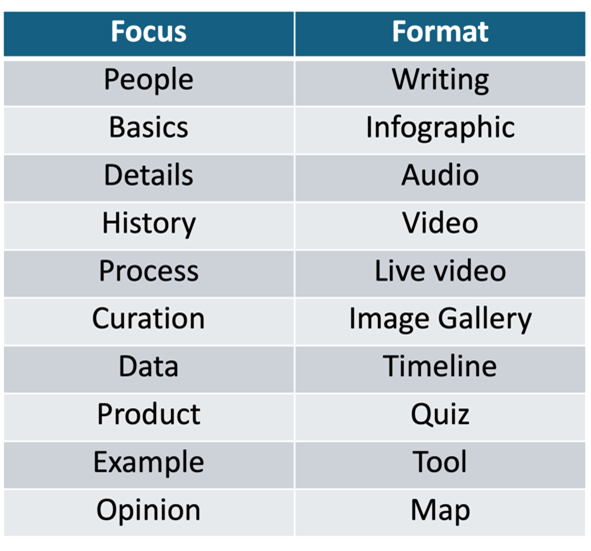
Think of the Content Fuel Framework as your lab notebook for content creation. In her book, Melanie describes The Content Fuel Framework as a simple way to decide what you’re talking about and how you’ll share it (Table 1). These are called the focus and the format. Below, we walk through both sets of categories with examples tailored to scientists, biotech founders, and researchers.
Like any research scientist, anyone who’s producing content must start with a clear focus. The focus provides the boundaries in which your content will cover. Here are the ten focuses you can start with as you decide what to highlight from your research:
For example, if you want to talk about your newly published research paper, you might place your focus on the details of your discovery or innovation. If you want to talk about your biotech startup, your focus might be placed on your unique technology and how it works, or the people who comprise your team. Both are topics that your intended audience would be interested in, whether for collaborations or investment in your company.
If you have an idea of what you want your audience to understand, you’ve found your focus.
Once you identify your focus, you can then start thinking about the format. Think of them like the reagents and equipment you use to run your experiments. Certain reagents and equipment are better for studying specific aspects of your research, and some formats are better for writing about certain topics. The Content Fuel Framework lists ten formats that you can consider to highlight your focus, which are as follows:
Here’s an example to consider. If you’ve decided that your focus is explaining the basics of a new paper to non-experts, your format options might include an explainer video or a short blog. If your focus is on making history by announcing a company launch to potential investors, your format might be a news-style article.
If you’d like to see Melanie’s original table and dive deeper into her method, check out her book The Content Fuel Framework and the resources on her website. Otherwise, make a 10×10 table with each row and column headed with each focus and format. Then, fill away! By mixing and matching them, you can create at least 100 different content ideas from your research!
Now that you have the Content Fuel Framework as a working guide, let’s walk through what using it will look like in the life sciences. I’ll use my own graduate school research as an example.
During my PhD, I worked on new ways to boost our immune system against infections. This relied on something called “trained immunity”, where certain innate immune cells can be taught to respond better the next time they encounter a threat. Think of it as giving frontline immune cells a “head start” before infection.
The thing is, too much training would be like adjusting the fire alarm to be so sensitive that it goes off every time you make toast! Excessive trained immunity in the body is more disastrous, however. It can lead to chronic inflammation and contribute to autoimmune and neurological disorders.
At first, there was no easy way to control where and how much training occurred.
Enter nanoparticles.
To keep the process of trained immunity safe and effective, I designed nanoparticles — tiny carriers that innate immune cells eat up — to carry molecules that induce trained immunity. These particles allowed the gradual release of the training molecules, reducing the risk of overreactions. This approach also helped us better control where training took place, limiting any adverse effects. With these two advantages, our team safely induced trained immunity in mice, protecting them from developing skin cancers.
Explaining nanoparticle design, immunology, and the idea of trained immunity to different audiences was not straightforward.
That’s where the Content Fuel Framework became extremely useful. By pairing different focus areas with specific formats, I could break the research into smaller “content experiments” instead of trying to explain everything at once. Here are a few combinations that came out of that process:
You can apply the same approach to your own work. Start with one project, pick a focus (Basics, History, Data, etc.), choose a format (blog, infographic, podcast, social post), and see what kinds of content you can produce from each combination. You will realize very quickly that one research project turns into a whole series of content ideas.
To keep your audience engaged over time, you need more than just ideas. You also need a simple plan for what to say, when to say it, and whether it’s working. That means checking three things each time you create new content:
A lot of this comes down to understanding your audience persona and how you want to guide them over time. We review the details of audience personas in a separate blog post. In the meantime, if you’d like a simple way to explore what order and type of content might work best for your business needs, try our interactive quiz below.
Life science professionals are rarely short on ideas. If anything, there are too many. The hard part is choosing where to start and feeling confident enough to publish it. It’s completely normal to feel underprepared or like you are not a real content creator. Especially when all your training has been in running experiments, not writing blogs or posts. One way to quiet that imposter syndrome is to treat content creation like an experiment too.
In this blog, we’ve walked through a scientific method for content creation, using Melanie Deziel’s Content Fuel Framework as a lab notebook. Just as you refine a broad research question into a clear hypothesis and protocol, you can refine a vague idea into a specific piece of content by choosing a focus (what you want to talk about) and a format (how you want to present it).
Content creation may seem intimidating at first, but if you treat it like any experiment by planning it, running it, and observing what happens, you’ll get better with each iteration. Over time, you’ll feel more comfortable creating content that keeps your audience engaged and also see yourself as a confident content creator, not an imposter.
Try coming up with one new idea today by pairing a focus and a format that fit your current project. Treat it as a small experiment, run it, and see how your audience responds.


Paul Naphtali is a seasoned online marketing consultant. He brings to the table three years of online marketing and copywriting experience within the life sciences industry. His MSc and PhD experience also provides him with the acumen to understand complex literature and translate it to any audience. This way, he can fulfill his passion for sharing the beauty of biomedical research and inspiring action from his readers.
Help your customers see the core of your life's work.
Let us translate your science and bring your marketing to life!