
I’ve spoken with a lot of scientists, freelancers, and executives who lament not getting the reach they hoped for on LinkedIn. They look at their impression counts plateau in the hundreds. Their like numbers aren’t going up, and they tell me that the LinkedIn algorithm is throttling their like counts.
In truth, I experienced all those signs, too. It felt like that no matter what I posted — video, image, or text — no one other than my friends and family looks at my posts. I tried posting every day, sharing a unique insight that no one heard before, and even considered paying to boost my posts at the right time.
As a former PhD-level scientist, I decided to put my research hat on and look into LinkedIn’s algorithm. Amid my search, once principle stands out above the rest:
LinkedIn wants you to stay on their platform for as long as possible.
LinkedIn is projected to receive over $11 billion in from ad revenue alone. With almost every person on Earth seeking a fulfilling work life, many of these users will interact and connect with other professionals to advance their careers. Keeping those users on LinkedIn is therefore crucial for their bottom line.
If you want to gain the most engagement on LinkedIn without paying a penny, you’ll need to know how to keep your audience engaged. That’s why I prepared six lessons in such a way that you can keep your audience engaged on LinkedIn through your content. They act as principles that you can apply no matter what kinds of algorithm changes LinkedIn throws at you.
Algorithm changes in 2026 would see experiencing a 50-70% reduction in LinkedIn impressions whenever they provided an external link directly on the post. The changes to the LinkedIn algorithm may change, but the algorithm still favours keeping users on their website for as long as possible. Even workarounds such as placing links in the comments are not preventing the reductions in LinkedIn reach.
Posting regularly demonstrates to your target audiences that you’re active. You don’t need to post every day or even every other day to demonstrate your expertise. All you need is to show your online presence in any way you can and to have a regular posting schedule. Posting in your own voice is also key. While AI-generated posts can help you with regularity, they fail to account for your specific value propositions without substantial prompt tweaking.
There are so many ways for you to post your content on LinkedIn. While the simplest approach involves using just text, LinkedIn has several ways to draw more users to your content. These can be divided into images and video. You can upload up to 10 images in a single post and share a video up to 10 minutes in length. This gives you potentially limitless opportunities to highlight your expertise on LinkedIn.
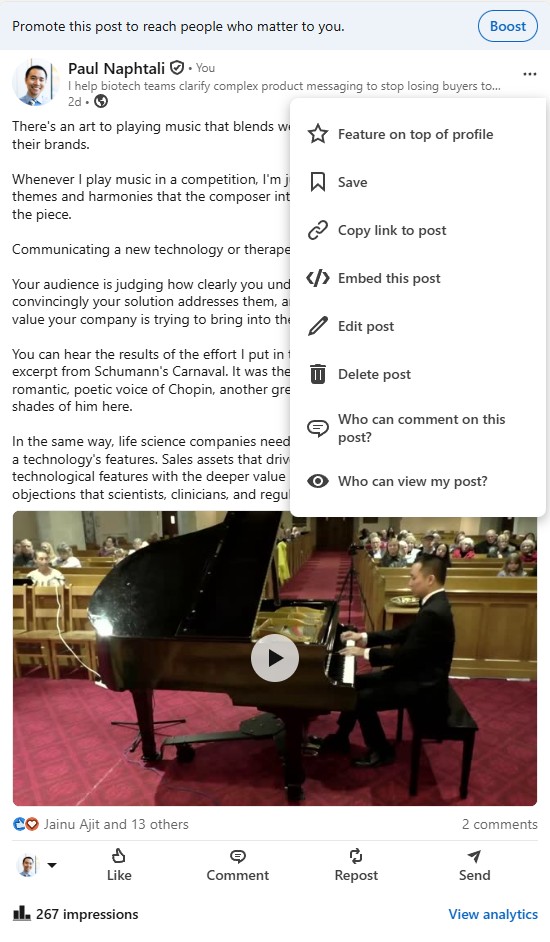
If you look at the LinkedIn post image to the right, you’ll notice a number of options available for a LinkedIn viewer. These options can be accessed by clicking on the three horizontal buttons at the top right section of the post. The one I want to point to is the “save” button.
According to several LinkedIn posts, the save button has quickly emerged as a primary tool for measuring a post’s reach and authority. The more saves a post has, the more it represents the usefulness of revisiting the post for later.
The changes are intended to improve the reach of content that’s worth referencing in future discussions. That means providing reference guides, templates, and other tools are fast becoming more useful in content generation efforts!
This is the second most important lesson that you’ll learn when you post on LinkedIn. In the past, people would game LinkedIn’s algorithms like it was Facebook or Instagram. Post your personal journeys and relate to a wide audience. Then, you’ll go viral and get a wide swathe of followers to your page. The only problem with that approach? None of the new followers are among your target audience.
You may feel the dopamine hit from getting a lot of likes, but none of those likes matter if those clicks and impressions aren’t generating conversations with the people who can buy your products and services. The only way you can get your customers into your sphere is to build content that addresses their pain points and needs. That requires knowing that your customers want to know about your products and writing content that continues to speak into that.
I’ve heard this happen extremely often. CEOs and other scientists create a post about their personal lives that go viral. Yet their professional content gets very few likes. Despite the few likes, the scientific expertise they offered created more leads than the viral post. What ends up happening is the personal journey garners a lot of interest from people at a similar stage in their journey, but not among your target customers who are looking for specific buying signals that may not necessarily go viral.
Posting on LinkedIn is an excellent way to share your opinions with your target audience. The immediacy of getting reactions from your target audience provides you with quick data to assess how well your content is landing with your target audience.
My client, a provider of consumables for culture-based experiments, engaged me to write a number of social media posts to help them maintain their LinkedIn presence and establish their authority with cell culture. Based on the six principles I listed, I pushed my client away from chasing broad visibility. Instead, I advised them towards producing tailored content that highlights the value behind their technology and how their products accelerate in vitro research.
My approach created a more focused audience response. The posts produced similar numbers of comments and reposts despite receiving fewer impressions and likes. From there, producing targeted content helped our client build more sales conversations with potential clients.
If you want to post on LinkedIn, you’ll need a sustainable approach that goes beyond chasing vanity metrics. GenoWrite focuses its efforts on a comprehensive LinkedIn strategy that produces diverse types of content that can engage with any audience.
Contact GenoWrite if you want a LinkedIn strategy that remains durable even with constant algorithm changes from client side.
Help your customers see the core of your life's work.
Let us translate your science and bring your marketing to life!