/

12 August 2026

Overcoming the Challenges of Building DNA with Ribbon Bio

Part 1: How Ribbon Bio uses cell-free DNA assembly to build difficult sequences faster
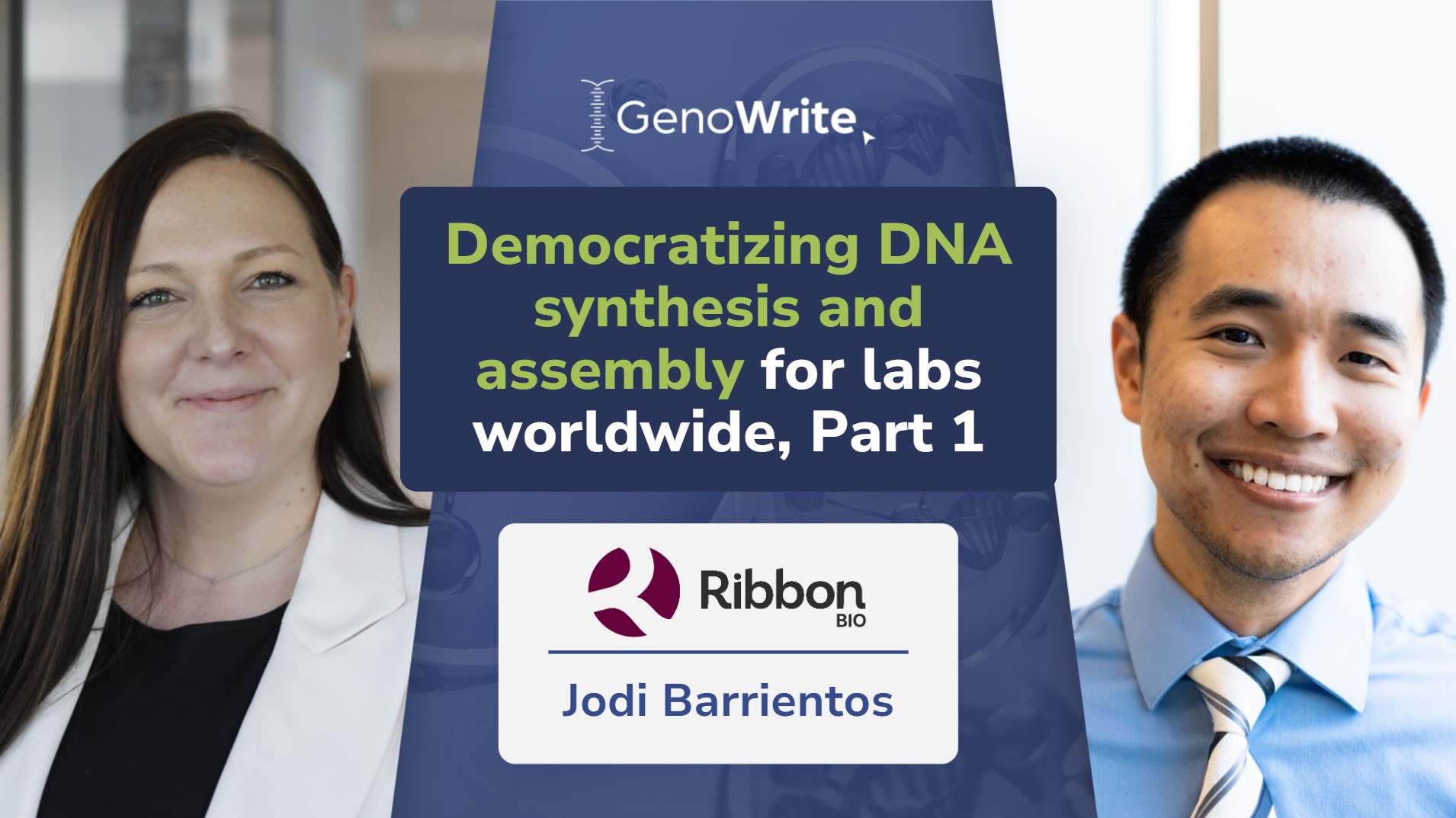
Interview feature of Jodi Barrientos, CEO of Ribbon Biolabs about democratizing DNA access

The mission to streamline DNA assembly

Much of the modern life sciences industry is built on what we know about DNA and how we manipulate it. Yet many DNA sequences remain a challenge to synthesize for a plethora of reasons.

Consider how we currently manufacture long or complex DNA sequences, for example. Molecular cloning remains the gold standard over 50 years after Herbert Boyer and Stanley Cohen invented recombinant DNA technology1. Yet many genetic sequences are toxic to the cells cloning them. The sequence could be viral, highly repetitive, or encode a key component of an mRNA vaccine. We also have to consider other factors such as DNA length and sequence composition.

Ribbon Bio’s CEO, Jodi Barrientos, encountered these exact problems when she tried to clone a particularly challenging sequence for one of her clients in Boston. With a lot of creative thinking and a penchant for trying something new, Ribbon Bio used the challenge as an opportunity to kickstart their cell-free DNA building platform.

As the company launches the MiroMine™ kit and MiroSynth™ Cell Free DNA products, I had the opportunity to speak with Jodi on a special two-part interview about Ribbon Bio. In the first part, we’ll cover what made the query sequence so difficult to build, the issues that Ribbon Bio’s technologies address for labs, and what developing cell-free DNA building means for molecular genetics and therapeutic development.

Learn more by reading the interview below!

The interview

The story behind Ribbon Bio: a challenging sequence

PN: Let’s start things off with the case study that doubles as the origin story for Ribbon Bio’s current form. Who were you working with, and what were they asking you to build?

JB: Two years ago, we were approached by a Boston-based biopharma company with a construct they’d been trying to manufacture for over two years. It was a viral sequence, and they needed it to continue work on important vaccine candidates. They tried seven different vendors and attempted to produce the sequence in-house.

All their efforts failed.

Then, we gave the sequence a try. Our process breaks down larger sequences into 1 kb fragments that we can assemble.

PN: That sounds like a really challenging DNA sequence to build. What biological constraints made that particular DNA sequence so difficult to work with, and how prevalent are these issues in other sequences you receive?

JB: The viral sequence we worked with was extremely challenging to build. Here are just a few features that made the sequence difficult to build and assemble:

  • For one, the sequence had a lot of repeats. These sequences form secondary structures that the cell’s machinery isn’t used to seeing. Long repeat sequences can also raise the risk of slippage, recombination, or genomic instability during amplification and propagation. All these factors increase the likelihood that the final cloned sequence differs from the intended design.
  • The viral sequence also had a very high GC content, sitting at 83%. Sequences with very high GC content can also form more thermostable structures that make the DNA harder to amplify and sequence.
  • The biggest issue arose when we cloned the sequence into bacteria. The intermediate sequences turned out to be toxic and unstable in bacterial cells.

With these issues at play, we decided to try our cell-free method. We developed the idea before the request, but we shelved it initially. Once we gave our cell-free method a try, we successfully constructed the sequence. From then on, we abandoned the cell-based cloning approach to use cell-free methods to build ready-to-use linear DNA constructs.

PN: It sounds like a classic case of evolving your products to meet the market’s needs and desires.

JB: It is. Given a finite budget, we have to decide what to prioritize and what gets set on the shelf. So, when we get ideas of what we could potentially do with our technology, we document the idea and shelve it in case it’s time to pull it out and be used.

A major piece of advice for startups, then, is to document all your product development ideas. You may have an opportunity to use them when you identify a new market need.

The logistical challenges with establishing existing methods for DNA synthesis and assembly

PN: As you were working on assembling the complex viral sequence, I imagine you uncovered the logistical challenges of cloning and synthesizing DNA as well.   

JB: Yes, we did. Most of the life sciences ecosystem will work with DNA at some point. Molecular cloning is one of the foundational tools for producing DNA. Labs can also synthesize short DNA oligos and longer sequences as well.

Yet in the life sciences industry, we still see scientists in high-demand markets waiting for months just to get access to synthetic DNA. With outsourcing DNA synthesis contributing to delays, scientists are left with building their own labs to clone or build DNA. But there are several constraints that scientists will inevitably face when making that decision:

Cost is the first issue

If you’re starting a new cloning lab, you’ll need a substantial investment to prepare the space and equipment to cultivate and harvest your bacterial clones. Some labs may also look to supporting in-house DNA synthesis and assembly. This would also require a large capital investment, with some systems costing hundreds of thousands of dollars to procure and install.

The second issue is setup

Cloning DNA is standard practice for building DNA constructs. Although the protocol itself is repeatable, it may still require setting aside substantial lab space and maintenance overhead to meet the appropriate biosafety requirements.

finally, labs must consider reproducibility

When you clone DNA into bacterial cells, you’re introducing biological variability. Even with a rigorous QC verification protocol, you may still observe cell-derived contaminants such as genomic DNA or residual proteins that compromise the purity of the DNA sequence. You may also have false positives in attempts to verify your final DNA construct.

Addressing the logistical challenges of DNA synthesis and assembly with Ribbon Bio

PN: Since the case study, you’ve launched the MiroMine™ and the MiroSynth™, two product paths for scientists to assemble long DNA sequences. How do they address the logistical challenges that we discussed?

JB: We developed two products for scientists with distinct DNA assembly needs. Both reflect our specialty in building complex DNA fragments with high purity and at affordable price points.

MiroMineâ„¢: DNA assembly on your lab bench

MiroMine™ is a benchtop kit that lets scientists assemble fragments up to 7 kb directly in their own lab. They don’t need to use bacteria since MiroMine™ implements a cell-free workflow. Additionally, the proprietary enzymes and Ribbon’s tailored protocols built from its proprietary algorithms are available in the kit. From there, a scientist can begin DNA assembly when they have the oligos ready and common lab equipment in place. With the MiroMine™ kit, any scientist can produce high-quality DNA sequences from their own benchtop without vendor timelines becoming a bottleneck.

MiroSynthâ„¢: Assembling more complex sequences as a service

Some sequences require more support than a benchtop kit can provide. For example, you could be looking at a DNA fragment longer than 7 kb to assemble. You may also be working with sequences with particularly high complexity. . For such cases, we recommend bringing the sequence to our team. We’ll use our specialized protocols — developed with our AI platform — and use our proprietary enzymes to ship you the fully synthesized molecule.

PN: What does addressing these issues mean for scientists as they study molecular genetics and develop cell & gene therapies?

JB: Ribbon Bio began by servicing the EU and US as our core markets. But when you think about it, the whole world needs DNA. And there are massive inequities in who gets it; many high-demand markets still need to wait for months to get access to DNA.

That’s not okay.

When we developed MiroMineâ„¢ and MiroSynthâ„¢, we had distinct needs in mind. With the MiroMineâ„¢, we had accessibility at the top of our minds. For the MiroSynthâ„¢, we focused on synthesizing highly complex sequences quickly. To move towards that, we partnered with oligo pool vendors so we could supply the building blocks that labs needed to build DNA sequences by themselves. If researchers want to build the molecules themselves, they can receive the kits within 2-3 business days at most.

Just by cutting down waiting times from months to days and removing the need to build complex facilities, you can facilitate therapeutic development across the life sciences. You can produce robust DNA templates that can be transcribed into mRNA therapeutics and vaccines. Similarly constructed DNA molecules can also be used as templates for cell-free protein synthesis without the constraints that come with cell-based methods. That’s not to mention viral recovery, vaccine research, synthetic biology, and other DNA-enabled workflows where speed, sequence accuracy, and purity matter.

For Ribbon Bio, the promise of cell-free DNA building does not only rest on faster DNA delivery. Ribbon Bio’s products make DNA-based experiments less of a bottleneck for the therapeutics, vaccines, and biological systems that depend on it.

Learn more about Ribbon Bio

Ribbon Bio has come a long way towards addressing some of the biggest bottlenecks in producing long and complex DNA sequences. The MiroMineâ„¢ kits are designed so you can produce the DNA yourself, while the MiroSynthâ„¢ product allows you to send challenging sequences like the viral sequence they described for synthesis. Either way, their products are designed to democratize DNA building across the globe.

If you want to learn more about the MiroMineâ„¢ kit and MiroSynthâ„¢ product, you can visit their website through the left button. If you want to know more about the inner workings of Ribbon Bio’s platform — sequence complexity measurements and where it fits into researcher workflows —the right button takes you to Part 2 when it’s online.

References

  1. Cohen SN, Chang ACY, Boyer HW, Helling RB. Construction of Biologically Functional Bacterial Plasmids In Vitro. Proc Natl Acad Sci U S A. 1973;70(11):3240-3244. doi:10.1073/pnas.70.11.3240

Author

  • Headshot of Paul Naphtali, an experienced life sciences content marketing consultant

    Paul Naphtali is a seasoned online marketing consultant. He brings to the table three years of online marketing and copywriting experience within the life sciences industry. His MSc and PhD experience also provides him with the acumen to understand complex literature and translate it to any audience. This way, he can fulfill his passion for sharing the beauty of biomedical research and inspiring action from his readers.

    View all posts

Thanks for visiting GenoWrite! 🎉

If you enjoyed this article, join our newsletter today!

You'll receive the latest news, tips, and tools for free!

Read our privacy policy here.

Share this article

Help your customers see the core of your life's work.

Let us translate your science and bring your marketing to life!