Think of your company’s website for a moment. If you don’t have a website, imagine how you’d like your website to appear. Along the way, I imagine that you thought of images, animations, and other visual features that would draw your readers to your technology at work.
That shouldn’t be surprising. Posts with images receive almost twice the traffic of posts without images. Almost all marketers also believe that visual content is important for strong digital marketing.
The statistics are clear: most appealing websites must draw your audience into your website and keep them there.
But what about search engine optimization (SEO)? The core process of ranking within a search engine has bots that crawl through and index your website. Those bots can’t process images. That’s not to mention accessibility for the visually impaired as an important component of SEO.
That’s where alt text comes in. In this blog, we’ll cover what alt text, how it helps you get seen on search engines as you add stunning images to your site, and how you can write effective alt text as a life sciences professional.
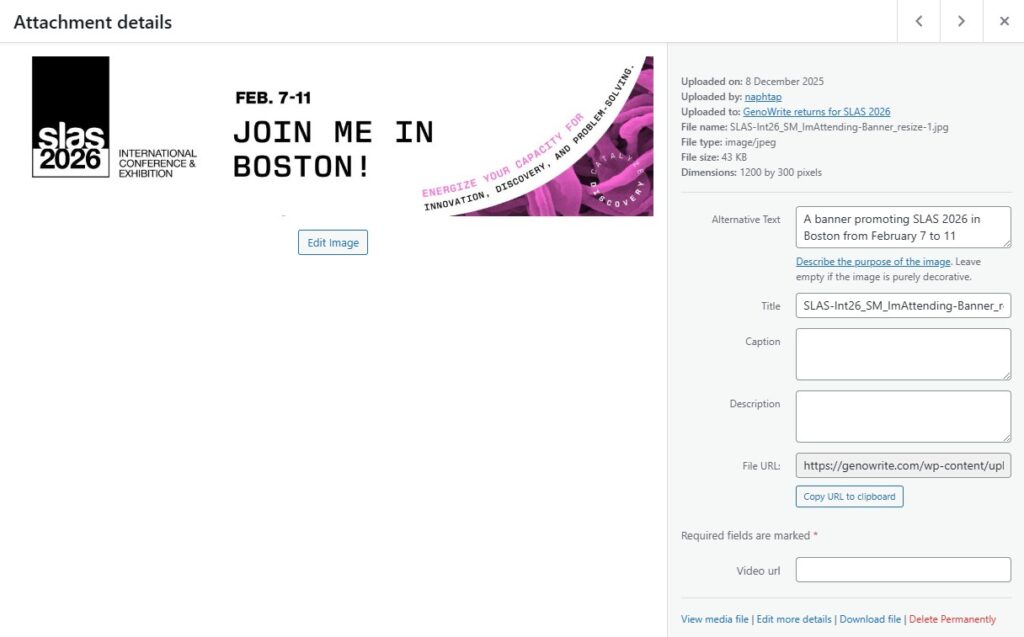
In short, alt text is a word-based description of an image. Alt text is short for alternative text, named as such as a different way to express an image. Whenever you upload an image, you’ll encounter a field where you can insert alt text. In WordPress, it will appear when you click on the image in the media library (Figure 1). Other website builders such as Wix and Squarespace will have dedicated fields where you can add alt text.
Filling in alt text may seem like a tedious task, especially with how many images you upload. But seemingly small tasks like these can add up to enormous benefits for anyone who visits your website. These benefits include, but are not limited to:
The life sciences industry prides itself on developing and implementing effective and inclusive solutions for all patients. Many of these patients live with visual impairments or other disabilities that prevent them from seeing too many images clustered at once. Here are a few examples of conditions that patients may have who would benefit from alt text:
Biotech and pharmaceutical companies committed to inclusive care must also ensure that anyone who visits their website can read it without setbacks. That’s especially true for healthcare and life science professionals tasked with championing patient well-being and inclusivity.
Alt images are also useful when visitors encounter technical issues loading your website. Poor internet connectivity that prevents specific images from loading, whether from internet timeouts or site crashes, are the most common technical issues readers will face. In such cases, alt text stands in whenever a specific image fails to load. That way, readers can still understand the research data you’re presenting despite encounter internet trouble.
Internet bots don’t process images like we do. When they crawl through your website, they will process any text that they come across. This includes web copy, HTML code, and heading and meta text. For images, web crawlers use alt text to determine the topics that the images relate to within the content you produce. When the images are relevant to the topics at hand, web crawlers can identify this to further boost your ranking on online searches related to your topic.
The best alt text shares a few common characteristics that provide a guideline on how you can write alt text. Here are the following characteristics:
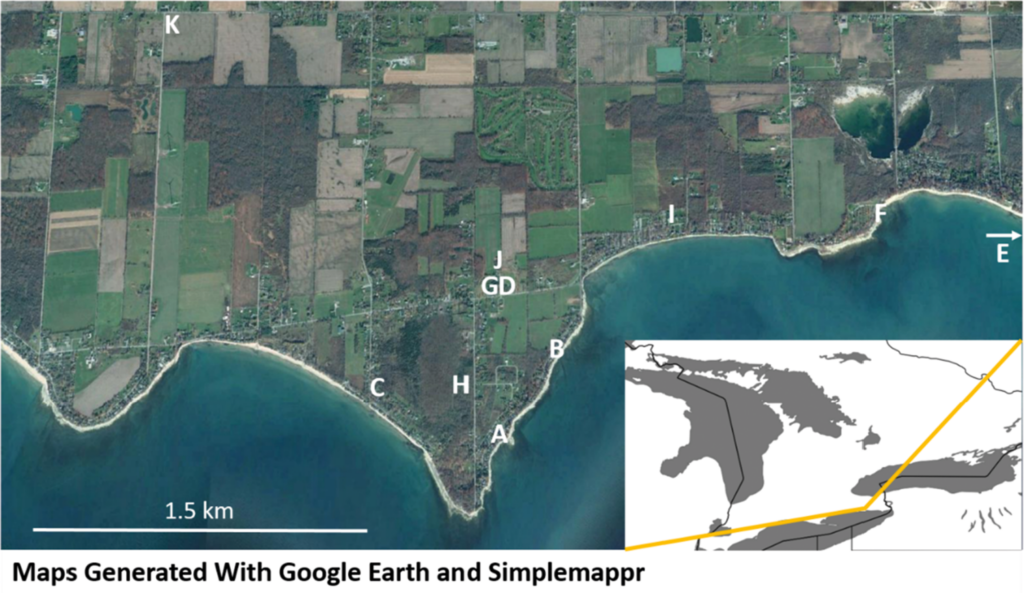
The best way to show you how to write alt text is to supply you with a few examples, which you can see below. Fun fact, all of these figures come from my first-author publication about fecal contamination in groundwater, the focus of my MSc research. Let’s start with a map of where I collected groundwater and fecal samples (Figure 1):
The alt map I chose was as follows:
Map depicting locations in Ontario where groundwater samples were collected for contamination testing.
You’ll see that it’s a short one-sentence blurb that meets the character limit. You’ll also observe that it relates to the image and only the image itself. Anything related to the captions is omitted. The alt text only covers enough information for readers and crawlers to see how the images relate to the website’s content.
In short, it’s a supplement, but an important one. Having a strong, relevant alt text can be the difference between ranking on the second page and the first page of a Google search result. More importantly, it makes websites accessible for all audience, a key goal of life sciences research.
If you’re like me before I learned about alt text, you probably have a huge repository of images for all the pictures you’ve uploaded onto your website. I’m here to say that the effort to add alt text to those images is worth it.
Still feeling overwhelmed? You don’t need to add all the alt text at once. Start with your most important pages: the homepage, key landing pages, and articles directly involved with your sales pipeline.
We’ll continue this discussion in an upcoming content series on creating engaging visuals for your website. To follow along and see how strong visuals, animations, and sales assets can strengthen visibility, authority, and trust, sign up for our newsletter using the left button below.
If you already know your images need SEO optimization but do not have the bandwidth to handle it yourself, speak with us using the right button below.

Paul Naphtali is a seasoned online marketing consultant. He brings to the table three years of online marketing and copywriting experience within the life sciences industry. His MSc and PhD experience also provides him with the acumen to understand complex literature and translate it to any audience. This way, he can fulfill his passion for sharing the beauty of biomedical research and inspiring action from his readers.
Help your customers see the core of your life's work.
Let us translate your science and bring your marketing to life!