Share this article
Help your customers see the core of your life's work.
Let us translate your science and bring your marketing to life!
The reproducibility crisis places an unsustainable tax on innovation. Difficulties in replicating research findings are costing the industry billions in experiments and stalling life-saving compounds before they ever reach a patient.
Many of these compounds fail because of inadequate efficacy and safety. Even the smallest structural modifications or formulation changes can affect drug exposure to the body. With such deep attention to detail required, questions as to whether manual workflows can achieve the necessary accuracy.
Self-Driving Labs® (SDLs) represent a new paradigm in scientific research and R&D, where AI and robotics augment scientists’ capabilities. This allows for a more structured approach by coupling automation, data collection, and experimental decision making in R&D. SDLs can potentially accelerate the pace of molecular discovery by a 100-fold, and automated testing expedites the identification of novel formulation strategies that improve clinical outcomes.
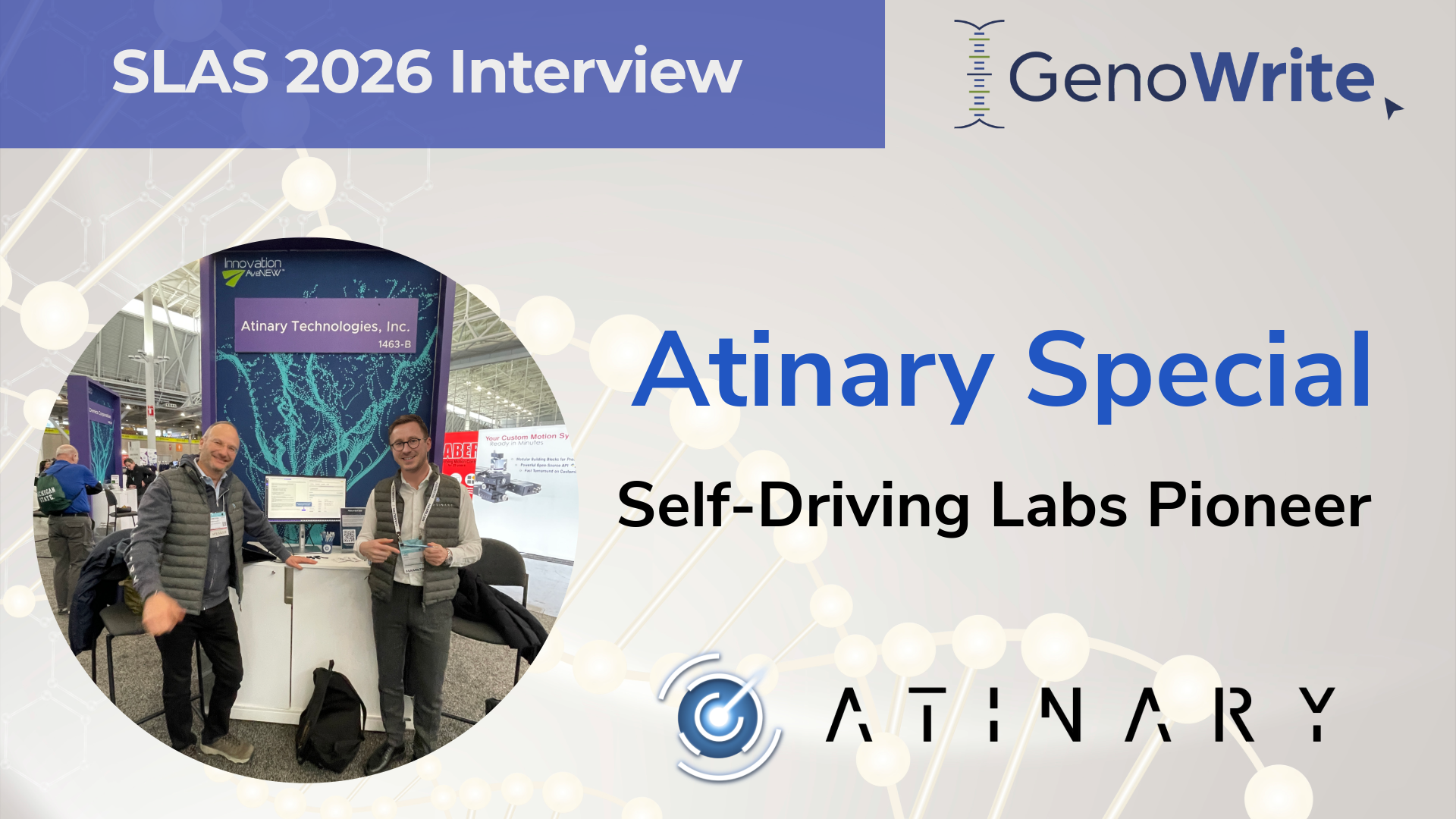
This potential is why I took up the opportunity to go on a lab tour at Atinary’s newly opened Self-Driving Labs® in Boston Seaport as I was attending SLAS 2026. Along the way, I spoke with several people on the Atinary team, including the Co-Founders who coined the term Self-Driving Labs® in 2017. Each of them gave their insights into the future of Self-Driving Labs® and Atinary’s strategic collaborations with major robotics and lab equipment developers, including ABB Robotics, Agilent Technologies, Bruker, Chemspeed, and Mettler Toledo.
The contributors for this series: Dr. Hermann Tribukait (HT) is the Co-Founder and CEO, Dr. Loïc Roch (LR) is the Co-Founder and CTO, Dr. Isabella Okuda (IO) is the Head of Labs, and Martina Löfqvist is the Head of Alliance & Strategic Growth.
Here is part 1 of the interview with Atinary about their SDL. This part will introduce SDLs and address practical concerns with running an SDL. Part 2 will be a technical deep dive into how SDLs are set up and operated. Finally, part 3 will feature a video where Martina previews the potential of SDLs to accelerate the development of molecules and materials from Atinary’s SLAS AveNEW booth.
PN: In 2016, Klaus Schwab popularized the term, “Fourth Industrial Revolution”, mentioning that it would include the implementation of self-driving systems. As the pioneers of Self-Driving Labs®, could you please describe what they are?
HT: Together with Loïc Roch (my Co-Founder and CTO), we coined the term Self-Driving Labs® in 2017. We developed this vision as part of the global innovation initiative known as the Innovation Challenge on Clean Energy Materials that I co-authored and led from inception in 2016 to 2019. The goal of this initiative was to determine how to accelerate materials discovery by orders of magnitude. The proposed solution to accelerate materials discovery exponentially is to augment research scientists with robotics and AI in R&D labs, that is, with Self-Driving Labs.
A Self-Driving Lab (SDL) is an autonomous, closed-loop R&D system that integrates artificial intelligence, robotics, and human expertise to revolutionize R&D and innovation. These systems automate the full Design-Make-Test-Analyze and Learn (DMTA-L) cycle. Altogether, SDLs represent the next frontier of AI: the transition of AI from the digital world into the physical world, specifically into R&D labs – what we call Physical AI in R&D.
PN: What about life sciences research makes SDLs the essential bridge between AI’s digital potential and the physical reality of the R&D labs?
HT: In life sciences, as in many R&D-driven industries, innovation is still constrained by a slow, manual, expensive, and tedious trial-and-error process. Scientists spend most of their time on manual tasks that detract from scientific pursuits, like preparing and running repetitive experiments, entering data, and guessing what to do next. It’s a human-driven process that is constrained by human abilities and the human mind and is not well suited to solve the scientific challenges of the 21st century. Here are a few examples to consider:
PN: How will Atinary’s Self-Driving Labs® address the bottlenecks in life sciences research?
HT: Atinary’s Self-Driving Labs® address these bottlenecks in a number of ways.
Once the data has been generated and analyzed, we can train the algorithms with these datasets and the algorithms then propose the next best set of experiments to run in the next iteration, and this process is repeated multiple times until we reach an optimum. Instead of running hundreds or thousands of experiments blindly, researchers converge on optimal molecules, formulations, or processes with dramatically fewer iterations. This means faster discovery cycles and higher success rates and enables scientists to tackle problems that were previously considered too complex or time-consuming to pursue. As such, SDLs allow scientists to focus their expertise where it matters most: on science and innovation, creativity, and ingenuity.
PN: Your mission mentions a healthier and sustainable future. In light of concerns about AI’s effects on the environment, how will your self-driving lab reduce raw material waste to support a circular economy?
HT: There are a number of ways that SDLs can tackle pollution and sustainability challenges.
Atinary’s next-gen agentic platform fundamentally changes this equation by maximizing R&D efficiency. Using Bayesian optimization and active learning strategies, SDLabs platform the global optima in complex combinatorial spaces while screening only a tiny fraction of all possible combinations. In practice, this means fewer experiments, less material waste, and dramatic reductions in hands-on time.
We have demonstrated this across multiple industrial use cases. For example, in catalytic process optimization with dsm-firmenich, we explored billions of potential combinations using fewer than one hundred experiments – reducing precious metal usage (rhodium) by 10 to 30 times and cutting its contributions costs by up to 97% from Є127/kg to Є4/kg. In another project with ETH Zurich SwissCAT+, objectives were reached by sampling only 144 observations in a space with more than 20 million combinations possible.
By eliminating unproductive experimental paths early, AI-driven R&D through Self-Driving Labs® reduces the physical footprint of discovery and enables more sustainable R&D workflows. At a broader scale, Atinary accelerates the development of catalysts, materials, and processes that support low-waste, energy-efficient manufacturing, which are key building blocks of a functioning circular economy.
If you want to learn more about the SDLs they’re building in Boston, subscribe to the GenoWrite newsletter by clicking on the button below on the left. You can also check out the Atinary website by clicking on the button to the right below.
Thank you to SLAS 2026 as well for facilitating the interview through our media partnership.
Help your customers see the core of your life's work.
Let us translate your science and bring your marketing to life!