
Share this article
Help your customers see the core of your life's work.
Let us translate your science and bring your marketing to life!
Single-cell omics assays are tricky. You have to keep the cells intact long enough so they can be placed into individual wells. Then, you need to lyse the cells and amplify the resulting DNA without letting the contaminants compromise the experiment.
Doing this work with microbial cells adds an additional layer of complexity. No two microbial species are exactly the same. One cell lysis protocol may work for some cells, but not for others. That makes it especially difficult to identify key features of individual cells, such as antimicrobial resistance (AMR) genes and other important disease biomarkers.
Enter Atrandi Biosciences.
They’re showcasing the Phyx, a platform that when combined with their Semi-Permeable Capsules (SPCs) is set to make the process of performing microbial single-cell sequencing much easier. Imagine being able to lyse, wash, and manipulate individual cells and retrieving pure nucleic acids from single microbial cells. The Phyx and SPCs make this possible.
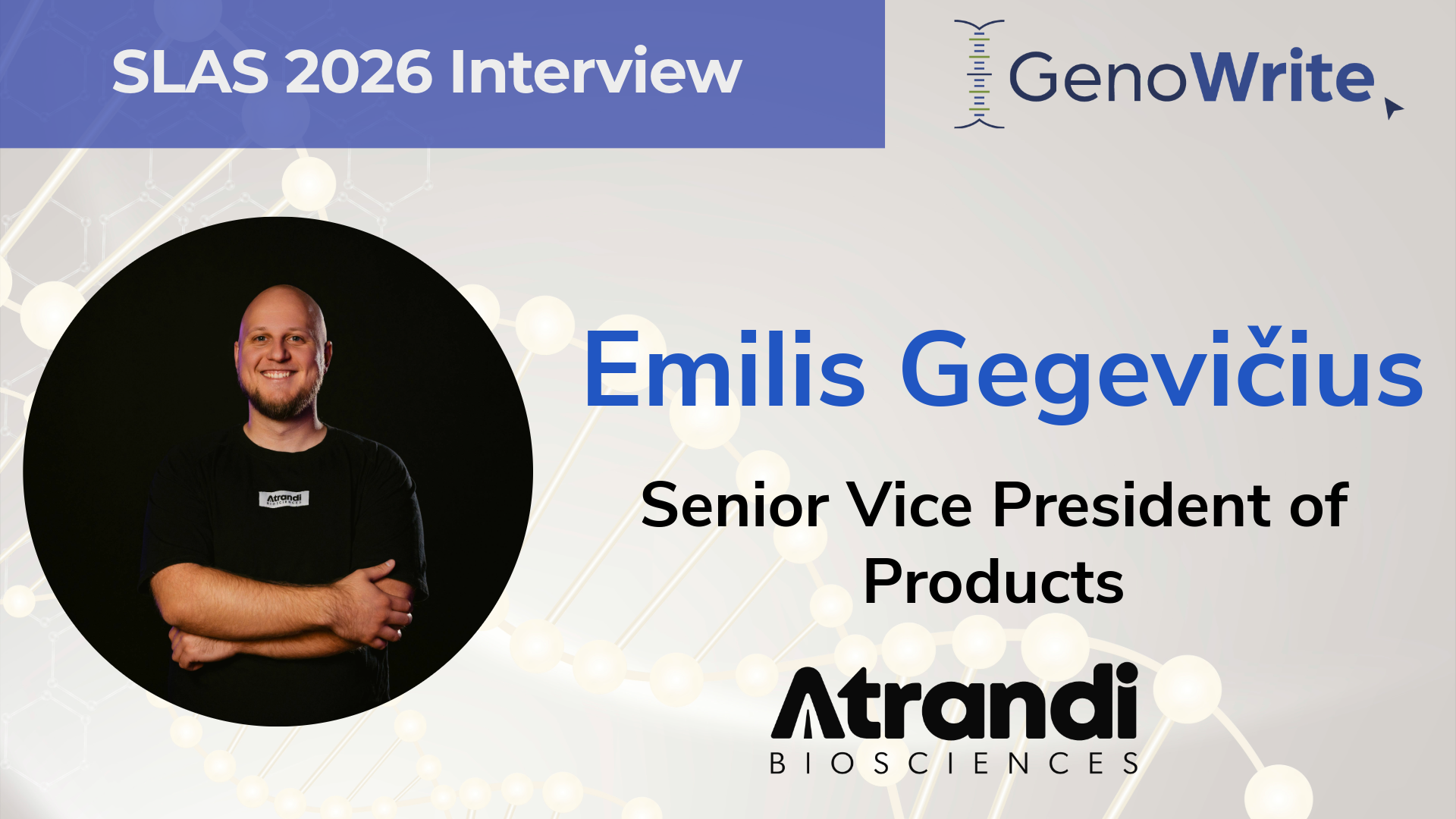
And now, I got the chance to speak with Emilis Gegevičius about the Phyx, Atrandi’s New Product Award contender. Read more about this gamechanger for microbial single-cell omics through the interview below!
PN: Let’s begin with the scientific rationale for developing SPCs for single-cell microbial genomics. What shortcomings do scientists face when working with droplet-based single-cell technologies?
EG: If you are used to droplet microfluidics, the simplest way to think about Atrandi’s SPCs is as an evolution of the droplet concept that makes true multi-step workflows practical at scale. A droplet is a closed, one-pot reactor. You can do droplet fusion or picoinjection — where you add reagents to individual droplets — but that adds complexity and custom instrumentation, and it can be hard to make it robust across different sample types. That becomes a real bottleneck in microbial single-cell omics, where organisms often require tougher, more variable lysis and cleanup than mammalian cells.
PN: How do SPCs address the difficulties in processing microbes for microbial single-cell omics?
EG: SPCs keep the key advantage of droplets, which is physical compartmentalization, but add what droplets fundamentally lack: controlled reagent exchange. The capsule wall acts like a molecular sieve; cells and long nucleic acids are retained, while smaller reagents and enzymes can diffuse in and out. That means you can lyse, wash, and run successive enzymatic steps in the same capsule while maintaining single-cell resolution throughout.
And this is the practical part people appreciate: reagent exchange is simple and you do it with standard lab handling — centrifuge and pipette — rather than specialized droplet hardware. The end result is a straightforward, stepwise add-and-wash workflow, but in parallel with hundreds of thousands to millions of individual cells. With SPCs, we’ve taken a major step towards making multi-step, single-cell workflows accessible without requiring every lab to become expert droplet engineers.
More broadly, once you can do reliable reagent exchange while preserving single-cell partitioning, the same concept extends beyond microbes. We see SPCs as a platform for sequential chemistries across many sample types, and over time, for multi-modality workflows that connect genotype and phenotype from the same cell.
EG: Yes, SPCs are well suited to complex communities. SPC-based single-cell whole genome sequencing has been demonstrated in challenging samples, such as:
With SPCs, we can recover large numbers of single amplified genomes and, importantly, assign genetic features to the cell they came from. That matters because microbiome biology — like strain differences, mobile elements, or antimicrobial resistance (AMR) genes — often gets blurred when you average across a mixed community. The Nature Microbiology study by Alaina R. Weinheimer and colleagues is a good illustration of scale and robustness in the complex real-world environmental samples. They recovered 2,037 particle genomes from just 300 nL of coastal seawater in a single particle genomics workflow.
PN: Let’s jump on AMR for a second because that’s such a hot topic in microbiology. How does analyzing cells at single-cell level help us fight AMR?
EG: AMR is often shaped by rare subpopulations, strain-level variation, and mobile genetic elements — signals that are easy to dilute in bulk or lose when linkage breaks. Single-cell compartmentalization helps keep genetic content assigned to the right biological unit. And that’s what allows you to connect resistance-associated genes or elements to the cells (or clones) that actually carry and express them.
PN: You’ve got yourself an excellent example of connecting genotype with phenotype in microbial research. Now, why does that matter for a microbiologist?
EG: Why does that matter? I ask instead, why doesn’t it matter? Most of the outcomes we care about are driven by heterogeneity. In real samples, the cells that determine therapeutic success or failure are often a small fraction of the population. If you only profile a few thousand cells, you might miss the rare state that predicts response, or the rare clone that persists, or you see it once and can’t really build a mechanistic story. When you can scale to hundreds of thousands of cells or more, those rare states become something you can measure, stratify, and follow with confidence.
PN: You mentioned therapeutic success or failure depending on single-cell heterogeneity. Can you elaborate on that?
EG: When it comes to therapeutics, you can take a treated sample and ask, “Which cells actually responded, which ones didn’t, and what makes them different?” What makes the cellular responses different could depend on the genotype, the mean expression state, or both. The point is not just to label responders and non-responders, but to get to the mechanism. What pathways were engaged? What state were the cells in before treatment? How did the individual cells change afterwards? With SPCs, you can capture those readouts cell by cell at the scale where the rare but clinically important populations actually show up.
PN: You’re showcasing the Phyx at SLAS 2026 this year. What prompted you to develop it?
EG: Phyx is really the culmination of more than a decade of us living at the intersection of single-cell sequencing and high-throughput screening. And in that time, we kept hearing the same thing from researchers: “I don’t need more data on everything. I need the cells that matter.” The rare clone, the responders, the unusual phenotype. But the way the field works today, you often sequence a huge amount first and only then discover what was interesting, and that’s where budgets disappear.
PN: Now, we get to hear how Phyx works! Tell us more about what it can do.
EG: People naturally use FACS, and it’s a fantastic tool, but it’s constrained by what you can measure and gate on. A lot of biology doesn’t fit neatly into a couple of fluorescent channels, especially when the signal is morphological, time-dependent, or easier to define through a quick molecular assay than a surface marker.
Phyx is built around a simple idea: screen broadly, then keep only the hits before you commit to deep profiling. What makes this possible for the Phyx is its screening mechanism. Instead of analyzing particles one-by-one in a stream-like flow, it analyzes particles in arrays. Our array system allows microbiologists to:
PN: It sounds like Phyx goes well above and beyond what existing FACS machines do in sorting bacteria.
EG: Yes, it becomes especially useful in single-cell whole genome sequencing. If the population you care about is rare, e.g., 1%, say a clone defined by a set of somatic mutations, the current reality is you end up sequencing a lot of background just to capture enough of the cells you want. With Phyx, you can do a quick molecular screen in the capsule, enrich just the capsules that contain the cells of interest, and then spend sequencing on the cells that actually answer your question. That can turn a “hundreds of thousands” experiment into something much closer to a few thousand, simply by not sequencing the background. The same logic applies when surface markers don’t get you there.
Not every cell type has clean antibody targets, and not every phenotype is on the surface, but every cell has nucleic acids. If the best way to define the state is a DNA or RNA signature, you generate a signal tied to that signature in the particle, then pick only the positives for downstream profiling. And it’s not limited to destructive assays. You can do phenotype-first selection too: grow spheroids from eukaryotic cells or microcolonies from microbes, perturb them with a drug or antibiotic, and select based on what you observe, such as growth, morphology, or reporter behavior.
The big point is that we, at Atrandi, want to make this kind of screening and enrichment practical for every lab. Something you can run as a straightforward workflow, not something reserved for specialized core facilities.
PN: I have to address an elephant in the room here. Many labs are not comfortable with using technologies that require proprietary reagents. How compatible are your SPCs with other machines and reagents, particularly for researchers who want to build custom assays for specific microbial targets?
EG: We totally understand that concern. Many of us on the team come from the bench, and nothing is more frustrating than being locked into a black box where you can’t adapt the chemistry to your biology. So, we’ve been intentional about making SPCs an open platform built for scientists and innovators in these ways:
At the same time, not everyone wants to develop methods from scratch. Many groups simply want a robust workflow that answers the biological question. For those labs, we provide end-to-end application kits, such as microbial single-cell whole genome sequencing and single-cell RNA&DNA co-sequencing workflows, where the chemistry and protocol are already packaged and validated.
On the instrumentation side, the barrier to entry is intentionally low. You do need a compact instrument to generate the SPCs, but after that, most of the workflows are standard lab handling: everyday lab tools, pipettes, tubes, and centrifugation as needed.
PN: Your responses have been so well-thought out! It’s no wonder you’re a finalist for the SLAS New Product Award! How does being a finalist fit within your goals for the Phyx this year?
EG: Thanks a lot! We are really happy to receive the honour.
For us, being a finalist is a strong signal that the broader scientific community is seeing Phyx the way we see it: not just as a niche microbiology tool, but as a complete platform that opens the door to a new category of high-throughput screening applications that fit how biology is actually done today.
Our goal for Phyx this year is straightforward. We want to get it into the hands of real labs, prove it across a handful of high-impact use cases, and make the experience simple enough to live on a normal bench. SLAS recognition fits amazingly well because it puts Phyx in front of exactly the audience we are building for: people who care about throughput, practicality, and reproducibility.
It also helps in a very practical way: when you are introducing something new, trust matters. Being recognized by SLAS accelerates conversations with early adopters, collaborators, and partners, and helps us focus Phyx on what labs value most: spending effort and sequencing capacity on the biology that matters, not on background. So, we see it as momentum that’s aligned with our focus this year, which is execution: real deployments, real data, and making Phyx something teams can rely on.
Help your customers see the core of your life's work.
Let us translate your science and bring your marketing to life!